Syria wiping neighbourhoods off the map to punish residents – rights group
 Satellite imagery taken over both cities
has revealed seven areas where neighbourhoods have either been largely
destroyed or totally demolished. None of the destruction was caused
during combat. Rather, the buildings have been systemically destroyed
using bulldozers and explosives placed by troops who first ordered
residents to leave, then supervised the demolitions.
Satellite imagery taken over both cities
has revealed seven areas where neighbourhoods have either been largely
destroyed or totally demolished. None of the destruction was caused
during combat. Rather, the buildings have been systemically destroyed
using bulldozers and explosives placed by troops who first ordered
residents to leave, then supervised the demolitions.
A report
released on Thursday morning says the Syrian regime claims that the
demolitions were part of an urban planning programme that aimed to
remove illegally constructed buildings.
Human Rights Watch,
however, claims the motivations were instead to punish areas that were
deemed to be sympathetic to opposition groups. It says the destruction
violated international law and the laws of war.
Claims of
widespread abuses have been routinely levelled by the government and the
opposition during almost three years of war in Syria, which has killed
more than 130,000, displaced close to 8 million, led tens of thousands
to disappear and battered the country’s renowned heritage sites.
However, the scale of the physical destruction has been difficult to
document, with reporting limited by government visa restrictions and the
intensity of the fighting.The Syrian government has demolished thousands of buildings, in some
cases entire neighbourhoods, in parts of Damascus and Hama, as part of a
collective punishment against residents of rebel-held areas, Human
Rights Watch has found.
“Wiping entire neighbourhoods off the
map is not a legitimate tactic of war,” said Ole Solvang, emergencies
researcher at Human Rights Watch. “These unlawful demolitions are the
latest additions to a long list of crimes committed by the Syrian
government.”
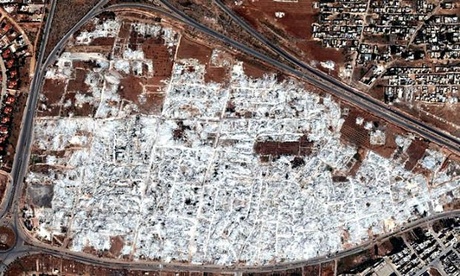
Using satellite imagery, the organisation has
compiled a dramatic series of before and after shots that it says show
145 hectares, the equivalent of 200 football fields, where the state
policy has caused near-total destruction.
Some demolitions took
place near areas such as the Mezzeh airbase and the international
airport that the opposition viewed as strategic. While acknowledging
that a military response in these areas could be deemed as legitimate,
the report claims that the response was disproportionate.
The
Mezzeh and Tadamoun areas of the capital, both opposition strongholds,
have been particularly heavily hit, the images show. In Hama, where
former president Hafez al-Assad killed tens of thousands of residents
and wiped out neighbourhoods over several days in 1982, widespread
destruction has again taken place. The satellite images show that the
Masha al-Arb’een area has been wiped out. One image, apparently taken
while the demolitions were under way, shows part of the area still
standing – a grey blob of buildings juxtaposed against a white backdrop
of ruins.

No comments:
Post a Comment